Total Pageviews

Sunday, March 2, 2014

FUN TIMES AND THE ROOT CANAL

SOMETIMES WE JUST GET LUCKY, Eh? February 12 - 28
February 12th we arrived in Desert Hot Springs, just 6 miles from beautiful Palm Springs, CA. Our intention was to stay 4 days, see the sights, and move on to Arizona.  After spending 2 hours at the Sands RV and Golf Resort we decided to extend our stay and got the special for newcomers...pay for 7 days and get 2 free.  The RV park was beautifully landscaped, well maintained, and full of fun loving young retirees enjoying the 9-hole golf course, pickle ball and tennis courts, swimming pool, fitness center, game room, yoga, hiking club and other scheduled activities available throughout the day.  About 60% of the guests are from Canada, and our fun and crazy neighbors were from British Columbia, and one couple from Wausau, WI.  We lucked out to find this great park and camping neighbors.
View from our camping site.
THE LAST HURRAH 
The day after arriving in DHS, we saw the Fabulous Palm Springs Follies perform their show "The Last Hurrah" at the historic Plaza Theatre in downtown Palm Springs.  This is the 23rd year of the Follies, and it is also the last; the final performance will be May 18th.  All the talented cast members are between the ages of 55 and 84, and have backgrounds performing on Broadway, TV, movies, or in Las Vegas productions.  Their high kicking and dancing was pretty amazing; I want what they're drinking! The costumes included elaborate showgirl costumes with huge head pieces, feathers and sequins. Maureen McGovern was the special guest star and still sings beautifully at age 65.  Belting out her Grammy award winning hit "The Morning After" (theme from the movie "The Poseidon Adventure") gave me goose bumps.
Entrance to the Plaza Theatre
Restaurants and outdoor cafes surround the theatre.
AERIAL TRAMWAY
The Palm Springs Aerial Tramway was another item we crossed off our bucket list.  The tram is unique in that the floor slowly rotated as it ascended the mountain and we were surrounded by the views of the Coachella Valley and San Jacinto mountains.  Panoramic views from the summit included Palm Springs, the Sultan Sea, and San Andres fault.
One of the two trams.
Each tram can hold 80 people. 
View from the tram. 
View from the mountain's summit.  Palm Springs can be seen the right side of the photo.
The San Andres fault is in the far distance.

JOSHUA TREE NATIONAL PARK
Poor planning took us to the Joshua Tree National Park on Saturday.  We should know by now not to go to these attractions on weekends.  Anyway, we had packed a picnic lunch, water, and hiking shoes, and joined the rest of the crowd at the Park.


"Mormon immigrants named the Joshua Tree after the biblical figure, Joshua, seeing the limbs of the tree as outstretched in supplication, guiding the travelers westward."
Spiky, twisty Joshua trees and unique piles of rocks and boulders give this Park an interesting landscape.  These trees need well timed rains and a winter freeze to produce springtime flowers at the end of a branch.
This rock formation is known as Skull Rock.
We met a Cub Scout Troop on our hike in the Park.
ABOUT AS MUCH FUN AS A ROOT CANAL
Throughout the weekend I was trying to ignore and self medicate the pain from a tooth ache.  Tuesday morning I couldn't stand it anymore so instead of joining the hiking club for a hike over the San Andres fault, I got on the phone to find a dentist.  I made an appointment with a Palm Springs dentist in the afternoon and received the distressing news that I needed a root canal.  I was referred to an Endodontic Dentist and had to wait until Friday for the procedure.  Since we were supposed to leave on Friday, we extended our stay at the RV park for another week.

I never thought I would look so forward to a root canal, but by Friday I was about out of mind with the pain and couldn't wait for it to be gone.  We arrived at the dental office, my name was called, and as I settled into the chair I looked around for the "gas tank" and was horrified that there wasn't one.  The only anesthesia I would get were shots of Novocain.  Because I'm a dental phobic, I always have plenty of drugs for this type of procedure; i.e. a tranquilizer 1/2 hour before getting in the chair, gas when I get in the chair, and then shots of Novocain after I'm floating and totally relaxed.  This was going to be a white knuckle ride!  I barely survived the torture, but by the next day the trauma from the procedure was fading and the tooth ache was gone; I felt like a new woman and we were able to enjoy exploring more of the area.
Thousands of wind mills produce energy for the area.


Wednesday, February 19, 2014

SOUTHERN CALIFORNIA

SOLVANG - Feb. 5 & 6
After "roughing" it at San Simeon State Park, we started heading south and pulled into an RV park that had full hook-ups as well as a laundromat.  The park was 4 miles from Solvang, that cute little tourist town in the St. Inez mountain area, where all the buildings have Scandinavian style architecture.  The constant and welcomed rain kept us from strolling around the town and browsing in the shops, but we did find a bakery with a parking spot right out front.  A cup a coffee and a couple of delicious pastries later, we headed back to the park.

VENTURING TO VENTURA
Thursday we drove down to Ventura, while Sandy and Bryan Brown drove up from Beverly Hills to meet us for lunch.  It was wonderful seeing those two; catching up with Sandy and what she's been up to since leaving her position as President of Transamerica Financial Advisors, and hearing Bryan recount his recent 2,400 mile solo kayak trip down the entire length of the Colorado River.  He's writing a book about the adventure and we're looking forward to reading it as soon as it's published.

DANA POINT - Feb. 7 - 11
Driving the RV while towing the Jeep through Los Angeles, and road construction on the 405, in NON-rush hour traffic gave us both tension headaches and a mighty thirst for a cold beer. I can't begin to imagine driving through there during rush hour.  Lucky us, we were able to get a campsite at Doheny State Beach in  Dana Point.  Again, this state park had no RV hook-ups, but roughing it was worth having a campsite practically on the beautiful beach next to the Dana Point Harbor.  We spent the weekend sightseeing and reconnecting with our southern California friends and family.

Dana Point is also known as the Surf Capital of southern California.
We were just a row back from having our campsite right on the beach.  After the weekend camping crowd left, we could see the beach from our site.  

Long time friend, Tony Goodrum, gave us a tour of Newport Beach, Balboa Island and peninsula.

Gary and Kaye Van Nevel joined us for a Mexican dinner at the Dana Point Harbor.

CHEERS! What's a Mexican dinner with out some Margaritas?  "Mucho bad-o" I'd say. 
Sunday we were invited to my cousin Sue McKenzie's home in San Pedro for brunch.  
After eating delicious gourmet lemon and blueberry pancakes, Mark and Sue took us to the Trump National Golf Course where we walked along the bluff over looking the Pacific. 

 This is Mark's in-home studio where is composing the music for at the next Dragonheart movie. 
Beautiful sunsets every night in Dana Point.

We had planned to leave for Palm Springs on Tuesday, but Gary and Kaye invited us to dinner at their home in Vista, so Tuesday we moved the rig to San Diego County's Guajome Park (pronounced GWA-oh-me).  The park was beautiful and Tuesday evening with the Van Nevel's a real treat.

Monday, February 17, 2014

CENTRAL COAST, CA February 2 - 4

SUPER SUNDAY
Super Bowl Sunday we left Bakersfield and drove to the west coast.  As we left the desert and entered the coastal range, it started to rain.  After getting set up at Hearst San Simeon State Park where we would be roughing it for the next few days with no electric, water, or sewer hook-ups, we headed into Cambria in search of a bar with a TV to watch the Super Bowl.
"Raindrops keep falling on my head."  Three inches of rain fell by Monday morning.

YEAH!  Seattle won!

A MAN'S HOME IS HIS CASTLE
Monday we toured part of the amazing Hearst Castle.  Casa Grande is the main house with a whopping 68,500 square feet containing 115 rooms including 38 bedrooms, a library, movie theater, kitchen and living quarters for the household staff.  We saw a very small portion of the house on our 1 hour tour.  William Randolph Hearst was a movie, newspaper and magazine mogul (aka media mogul) and inherited this land from his wealthy parents.  In 1919 he hired a woman architect, Julia Morgan, (which was very rare for the times) to design a little ranch house on the hilltop where Hearst often camped in tents.  With Hearst's dreams and blank check, and Morgan's talent and eye for detail, they collaborated on building the massive estate on the hilltop with expansive views of the coastal mountains and Pacific Ocean. The property is furnished with many priceless museum quality pieces of art obtained by Hearst between 1919 and 1947.  When doctors told him he was no longer able to go the the "ranch" at San Simeon, Hearst gifted items to family members, as well as selling and donating other art pieces to museums.
The little ranch house at the top of the hill.

The ceiling in the living room was recycled from a "tear down" castle in Europe.
The antique tapestries hanging on the walls are priceless.

The Neptune pool is losing water because of a leak.  It isn't being refilled because of the severe drought .

Standing in front of Casa Grande. 

Admiring more art work.

The indoor Roman pool.

THE NATURE CHANNEL - LIVE!
The beach along Highway 1, just north of our campground, is the Piedras Blancas Elephant Seal Rookery.  We stopped at the viewing area above the beach where thousands of these huge mammals arrive every January and February to give birth and breed.  We walked along the walkway, just feet from the sights, sounds, and smells of these unusual creatures doing what they do.  The adult males were bellowing and getting into bloody fights with each other over dominance for part of the beach where the harem of females nursed their babies and squawked their annoyance when a male picked her out as his next love interest.  The males are massive and look unusual because they have a proboscis (long nose that looks kind of like an elephant's trunk).  An adult male will weigh as much as 5,000 pounds;  and the females can grow to 1,800 pounds.  At birth the pups weigh 60 - 80 pounds and can weigh 250 to 350 pounds when they are weaned just 28 days after being born.
Front right of the photo are 2 adult males fighting it out for the ladies.  One of them ended up with a bloody neck.


Sunday, February 2, 2014

LAND OF FRUITS AND NUTS

BAKERSFIELD, CA - Oct. 23 - Nov. 1, 2013
October 23rd we left the Sequoia National Park and headed south through central California and the San Joaquin Valley to Bakersfield, which is also home to Jim's cousin, Irene. About 20 miles out of town Irene's son David and daughter-in-law Audrey live on a ranch.  After a week visiting and exploring we drove the RV to David and Audrey's place, closed it up and parked it and the Jeep for the next few months.  
Audrey, David and Murphy at the ranch.
Jim, Irene and Rosie

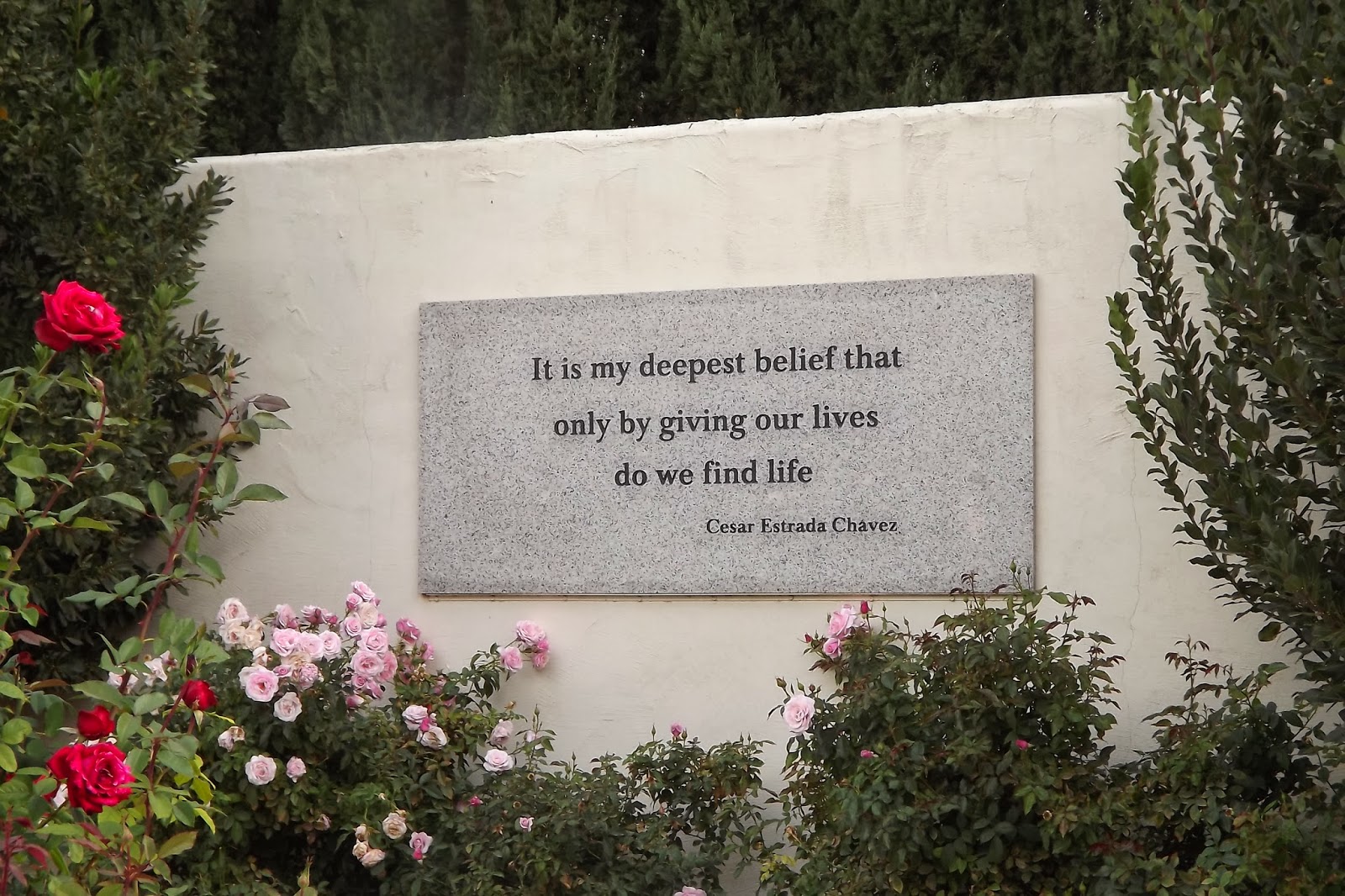
Cesar Chavez National Monument.  In the 1970's, Cesar Chavez led a non-violent farm labor strike and
table grape boycott which resulted in improved working and living conditions for migrant farm workers.
Buttoning up the RV until we get back to California.

Nov. 1 we boarded a plane and flew home to spend Thanksgiving, Christmas, and New Year's with family and friends.


PICKING UP WHERE WE LEFT OFF - Jan. 28 - Feb. 2, 2014
As soon as Christmas was over we began planning our escape from the freezing death grip  the Polar Vortex had on Wisconsin.  On January 28th we woke up to a typical Wisconsin morning with the outside thermometer hovering at -30 degrees.  
Although it was ungodly cold, we had a smile on our faces because we could shed our long under-ware, wool sweaters, boots, and layers and layers of clothes; by the end of the day we would be in sunny California.  There was over a hundred degree difference in temperature from when we woke up to when we stepped off the plane in Bakersfield that evening; our bodies thanked us and immediately started to thaw out.  Irene met us at the airport, fed us, put us up for the night, and the next morning drove us to David and Audrey's to pick up the RV and Jeep.

LAND OF FRUIT AND NUTS
While driving around the San Joaquin Valley it's easy to see why this area is know as "The Food Basket of the World".  Hundreds of thousands of acres are planted with almond and pistachio trees, citrus orchards, as well as vineyards of table grapes thrive in this irrigated desert valley.  This part of California is also the State's primary oil producing region; hundreds of wells clustered together in oil fields, as well as scattered in and among the fields of grapes and orchards, pump liquid gold day and night.
Bakersfield oil field.
Winter in California is supposed to be the rainy season, but most of California is experiencing a severe drought and is desperate for rain.  It sprinkled 1/16th of an inch on Thursday, which is the only moisture that has fallen from the sky this month.  Agriculture production is being severely threatened by a state-wide water shortage.

GRAPES OF WRATH
Friday we took a drive with Irene to the migrant camp made famous by John Steinbeck's book "The Grapes of Wrath".  The camp is still in operation, but has been improved with modern housing units available for migrant workers and their families.  Three of the original buildings from the 1930's are still standing and are in the process of being restored for historical preservation.
Original building at the Sunset Migration Labor Camp, Arvin, CA
Housing at the Sunset migrant labor camp.
We also stopped at the Bakersfield Museum of Art to view an exhibit of photographs documenting the plight of migratory farm life during the Great Depression.  This exhibition is in commemoration of the 75th anniversary of Steinbeck's Pulitzer Prize winning novel.  While Steinbeck interviewed farm workers, Horace Bristol photographed the workers and  living conditions in the labor camps.  The exhibit features 37 prints by Bristol which exemplify the central characters in "The Grapes of Wrath".

Monday, October 28, 2013

HIGHS AND LOWS

Sequoia and Kings Canyon - October 21 - 23
South of Yosemite are Sequoia and Kings Canyon National Parks; our next destination.  The topography changed dramatically as we drove out of the Sierra Nevada Mountains, through the foothills, and into the San Joaquin Valley.  At Fresno, we turned east and again entered the foothills of the Sierra Mountains.  We set up camp at an RV park in the town of Three Rivers, not far from Sequoia and Kings Canyon National Parks.

GIANT FOREST
Sequoia National Park's Generals Highway zigs and zags through the foothills and then into the mountain pine forests before getting to the sequoia groves.  Sequoias grow naturally only on the west slope of the Sierra Nevada, usually between 5,000 and 7,000 feet of elevation.  Because of the narrow hair-pin curves, it takes an hour to get from the park entrance to the first visitor's center.  Most of the mountain road is restricted to vehicles less than 27 feet long.

Although sequoias don't grow as tall as redwood trees, sequoias are giant and ancient. When sequoias quit growing in height, they continue to produce new wood on their trunks and branches.  The tree bark is about 2 feet thick. 
The thick bark as well as natural chemicals in the wood and bark, provides insulation to fire, and
resistance to insects and fungi. New bark is continually growing and will eventually cover the fire scar.
I'm not sure what the celebration was about, but a priest and group of people were singing beneath the trees.
Because of a shallow root system with no taproot, soil moisture
 as well as root damage and strong winds can topple these massive trees.
The largest of these trees is named the General Sherman, which is estimated to be 2,200 years old, is
 225 feet tall with a trunk circumference at ground of 109 feet, and it's largest branch is almost 7 feet in diameter.
We took a bumpy dirt road to Stump Meadow in Sequoia National Forest.  Logging was stopped in
 the late 1800's as residents in the San Joaquin Valley urged Congress to protect Sierra tracts from logging.
KINGS CANYON
We drove out of Sequoia NP, through part of the Sequoia National Forest, and into Kings Canyon National Park.  After maneuvering the twisting roads of Kings Canyon Scenic Byway to the canyon floor, we stopped for an ice cream cone at Kings Canyon Lodge.
Ice age glaciers carved these deep canyons. Elevations range from 1,500 to 14,500 feet.
The welcoming committee at Kings Canyon Lodge.
These old gas pumps at the lodge are still in operation, but at $4.95
 per liter, with a 5 gallon minimum, I'm glad we didn't need to buy any gas.
 
WINNERS AND LOSERS
One day we stopped at a restaurant near the entrance to the Park.  Jim asked the owner how much the government shut-down had hurt his business.  He said "It was pretty bad.  The only one who came out ahead around here on that deal was the guy that owns the Hardware Store.  A lot of "honey-do" lists got done."
  

Friday, October 25, 2013

POLAR OPPOSITES

Sacramento, CA - October 16
THE TWILIGHT ZONE
Jim had a telephone conference call/meeting scheduled for Thursday morning, so a week earlier we decided to be in Sacramento on the Wednesday before so there would be a mailing address for the meeting materials to be sent, as well as good cell phone service.  Jim made a reservation at an RV park he picked out of the Trailer Life Directory and let the manager know that a package would be arriving for him and to hold it until we got there.  "No problem", said the manager.

So, Wednesday, we reluctantly left the peaceful energy and exquisite beauty of Mount Shasta.  We arrived in California's capitol city with the noise and traffic congestion that goes with it, and found the RV park which turned out to be an old classic trashy trailer park with a closely packed menagerie of 40 year old mobile homes, permanent RV's, various vehicles, and colorful characters who live there.  It was like waking up and finding out I had just entered the Twilight Zone; Mount Shasta and our new address in Sacramento were polar opposites. When Jim asked about the Fed Ex package he was expecting, the manager said "Oh, that's you?  I didn't know who that package was for, so I sent it back".  Jim was pissed, and I tried to stay in my Mount Shasta Zen zone.

WELCOME TO YOSEMITE!  October 17 - 21

Thursday morning we heard the news; the government shut-down is over and all National Parks and Monuments will open immediately.  YIPPEE!  While Jim was finishing up his telephone meeting, I looked for a campsite in/by Yosemite.  We couldn't get out of Sacramento fast enough.

Our campground was located in a canyon near the small town of El Portal.  Friday morning we arrived at the Arch Rock entrance into Yosemite National Park and were greeted by a smiling park ranger; "Welcome to Yosemite!" she said.  It was obvious that the Park rangers and concessionaires were happy to be back to the jobs they love.

The landscape of Yosemite is dramatic and diverse.  Melting glaciers sculptured, smoothed and polished the huge granite mountains leaving massive rocks and huge boulders stranded on and around the cliffs and in the Merced River.  Stunning waterfalls, and forests of giant fir, cedar, black oak, and large leaf maple trees, and mountain meadows add to the spectacular panorama of the mountains and Yosemite Valley. 
"It is by far the grandest of all the special temples of nature I was ever permitted to enter" - John Muir

"Nature undergoes constant transformation, with rock falls, fires, and floods changing its appearance." 

Vernal Fall

El Capitan - the worlds largest granite monolith.  Can you see the "heart" of El Capitan in the center? 
Half Dome


Arch Rock, a natural tunnel.

Olmstead Point
The bears living in Yosemite are smarter than the average bear and will destroy your vehicle to get inside and steal your picnic basket.  While hiking the trails, all coolers, food, and beverages must be stored in these bear proof storage lockers located at the trailhead parking lots.  Leaving food inside vehicles overnight results in a $5,000 fine. 
View of Half Dome from Glacier Point
Driving through a golden corridor in Yosemite Valley. Fall colors were at their peak.

Not much water was crashing over Bridal Vail Falls during this dry season.  I would love to see it with the Spring run-off.
Yosemite Falls was completely dry this time of year and is referred to as "Yosemite Wall".