Total Pageviews

Saturday, July 1, 2017

PALMER, WASILLA, & ANCHORAGE

JUNE 18 - 27

While exploring this part of Alaska we set up our base camp in Palmer, AK, at the Mountain View Campground.


SLED DOGS

The world famous Iditarod Dog Sled Race is held every March and covers over 1,000 miles from southwest Alaska in Anchorage, to Nome on the western coast of the Berring Sea.  Until the introduction of snowmobiles, the trail was once a supply and mail route to villages that could only be reached by dog sled.  Joe Reddington, Sr., made it his life's work to save the historic trail, the culture of dog sledding, and the Alaskan breed of huskies.  The first Iditarod race was held in 1973 and has grown over the years with mushers from all walks of life, coming from all over the world, to compete in this grueling test of endurance, for man and dogs, through some of the most scenic and extreme weather conditions Mother Nature has to offer.

The highlight of our visit to the Iditarod Headquarters was taking a short ride in a cart pulled by sled dogs on a trail through the woods.  As we approached the area for the cart ride, the team of dogs were laying down until they saw us give the musher our tickets.  Oh my, the excitement began!  All the dogs started barking, jumped up, and started wagging their tails, as if to say "let's get going!"  Sled dogs are working dogs and they like nothing better than to run, and to run fast.


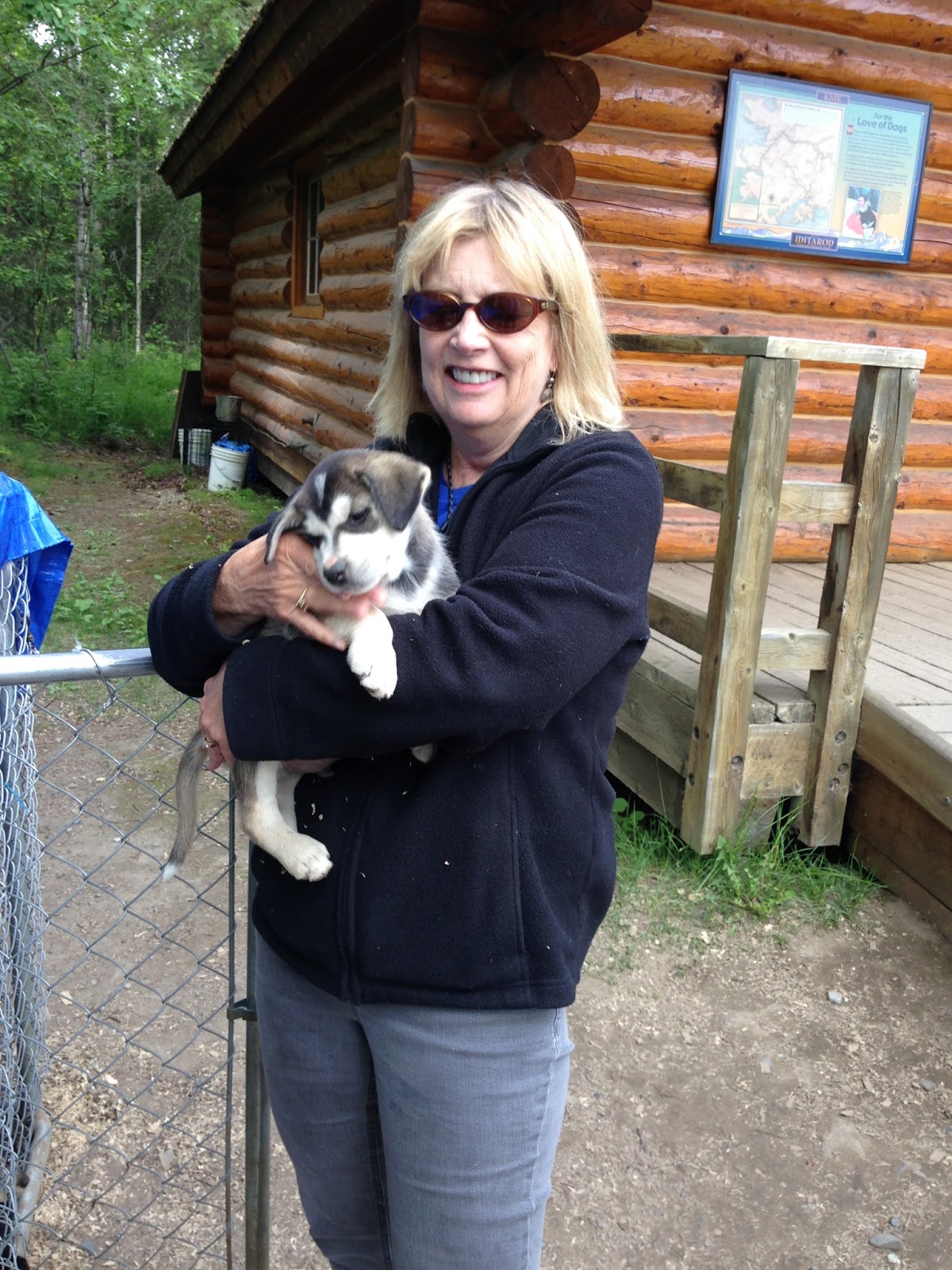
Ah, who can resist a puppy?
And, if you are wondering if we saw Sarah Palin while in Wasilla, the answer is "No".  I believe she was at home looking at Russia from her kitchen window.

FAMILIAR FACES IN FAR AWAY PLACES

MATT
The evening before leaving Palmer, Jim got a call from our grandson, Matt, who had been on a fishing trip out of Seward.  "Hey, grandpa, I'm in Wasilla.  How far are you guys from Wasilla?"  We got in the car, drove 12 miles to where Matt and his buddy, Aaron, were staying, picked them up and went out for a couple of drinks where we swapped tales of our Alaskan adventures.  Getting to see Matt and Aaron was the highlight of our Palmer visit.
What a wonderful surprise to see Aaron and Matt.

BOB
Anchorage was our next stop where we got together several times with Bob, Jim's step-brother.  Bob relocated to Alaska after spending time stationed there in the military. He's lived in Anchorage for over 20 years so had plenty of hunting, fishing, and mining for gold stories to tell us.   He also makes a mean canned smoked salmon...delicious!
Bob and Jim 
TIM & JILL
Our friends from Bass Lake, Tim and Jill Reimenschnider, contacted us saying they would be in Anchorage for the weekend.  Friday, the four of us drove to Whittier, a small coastal town, which until 2000, could only be reached by train, plane, or boat.  In 2000, the 2.5 mile train tunnel running through the mountain to Whittier was modified to handle trains and automobiles.  At the end of the tunnel is an abandoned U.S. Army base, a few gift shops, restaurants, a couple of hotels, and fishing charter and tour boats.  This makes up the town of Whittier.
A great day spent with friends amid the amazing Alaskan scenery.
Alasken brew!  The bartender said their bar had been voted "Best Water" for that past several years. 
Cheeseheads in Whittier.
A COLORFUL DAY IN ANCHORAGE
Saturday, June 24th, marked the 40th anniversary of the Anchorage Gay Pride Parade.  Of course we had to go, since we'd never been to a gay pride parade.  We met Tim and Jill downtown, watched about 20 of the 150 parade units, then headed out for Bloody's and Brunch.
At the intersection of F Ave. and 7th Street, we were at the center of the action.  The commentary of the parade MC was a hoot, and Anchorage's Finest was present to make sure every one stayed safe.

At the 1st Anchorage Gay Pride Parade, 40 years ago, participants wore paper bags over their heads
because they were afraid of being fired from their jobs, losing their housing, or being violently attacked.
Thank goodness a lot has changed in the past 40 years!
Anchorage offers a lot of support and services to the LGBT community.

Straight or LGBT, it didn't matter, the parade was all about Peace, Love,Tolerance and Acceptance.
  "We are all One".

Hilarious and goofy costumes made for a great people watching.
OUR 49th STATE
This park in Anchorage commemorates Alaska's inclusion to the United States in 1959.
June 27th we left Anchorage and headed south to the Kenai Peninsula.


Wednesday, June 21, 2017

COPPER CENTER - JUNE 15 - 18

Worthington Glacier 
Getting a late start, as well as stopping to gawk at cascading waterfalls, the Worthington Glacier, and delayed by road construction, we only got 100 miles from Valdez before we pulled into the tiny town of Copper Center on Thursday afternoon.  

THE SALMON ARE RUNNING!
The banks of Kultina River flowing through Copper Center were lined with fishermen and women casting their lines into the swift moving water.  This river is know for red Sockeye Salmon; so, with the salmon running and it being Father's Day Weekend,the campgrounds were packed to the gills (no pun intended) and we were lucky to get a campsite.
The manager of the campground squeezed us into a site next to Kathy and Steve, a great couple from Fairbanks.  The RV's were so close that if our awning was fully extended Kathy and Steve couldn't open their door.  With both of us having no kids and no pets, we were perfect close neighbors.
Like umbilical cords, electrical extension cords snaked under and around RV's to supply power.  We had to be careful not to trip over the wires.


Our neighbor Kathy was an avid fisherwoman and worked hard to catch her daily limit.


We had a freezer full of halibut and Kathy and Steve had a freezer full of salmon; a fish exchange was made and everybody was happy!

Before salmon roe could be used for bait, mounds of it were sprinkled with Borax and set out in the sun to dry.

LARGEST NATIONAL PARK IN THE U.S. - WRENGELL-ST. ELIAS

The fish camp was located near the largest national park in the U.S. and a perfect location for day trips to explore the surrounding area and Park.  Created in 1980, and covering 13.2 million acres, Wrangell-St. Elias National Park and Preserve is equal in size to 6 Yellowstone National Parks, and is larger than the country of Switzerland.  This enormous park is home to 4 major mountain ranges, 9 of the16 highest peaks in North America, and contains over 150 glaciers.  The mountains are volcanic in nature, although Mount Wrangell is the only active volcano with steam escaping near the summit. 

CHITNA - An almost ghost town.
The town of Chitna has seen better days.
The McCarthy Highway passes through the town of Chitna which ends 60 miles away at the towns of McCarthy and Kennecott, in the heart of Wrangell-St. Elias N.P. 

We stopped at the visitor center, where an enthusiastic N.P. employee told us about the area and gave us an audio tour CD for our 60 mile drive to end of the road at McCarthy.


Along the Copper River in Chitna, locals were dip-netting salmon.

KENNECOTT COPPER MINE
McCarthy Highway is a gravel, washboard, potholed road that follows an abandoned railway, with bridges spanning the rivers and mountainous terrain. The railroad was built in 1911 to transport copper out of Kennecott and was abandoned when mining stopped in 1938. In the 1960's, the railroad tracks were removed and the McCarthy Highway was born.

We arrived at the end of the road, parked the car, walked across the river on a foot bridge, and boarded a shuttle van for a 6 mile ride to Kennecott, an old mining town that is a National Historic Site.


Kennecott was built on the edge of a glacier.  While the glacier has shrunk about 200 feet in height over the past 80 years, the moraine covered glacial ice you see between the building and the mountain is about 300 feet thick.  


Between 1911 and 1938, over 200 million dollars worth of copper was mined and processed at Kennecott.


The McCarthy saloon and town residents provided a distraction for hard working miners.Kennecott was a self-contained company town and the mining company prohibited liquor, and encouraged wholesome activities.  Because the town was "dry", miners looking for a little excitement, would walk 5 miles down the train tracks to the town of McCarthy, where they could gamble, drink, and cavort with wild women.


Thursday, June 15, 2017

VALDEZ - JUNE 11 - 14

The drive to the west coast town of Valdez on the Richardson Highway is incredibly beautiful with majestic snowy mountains, the Worthington Glacier and Bridal Vail Waterfall being highlights.
Bridal Vail Falls.
Across the highway we heard the thundering roar of the water,
and felt and the mist from the waterfall as it hit the ground and sprayed into the air.
HAPPY HOUR WITH THE EAGLES
We pulled into Bayside RV Park for a 2 night stay that turned into a 4 night stay.  With a campsite facing the rugged snowy mountains and overlooking a wildlife preserve, this prime piece of real estate couldn't be beat.  In addition to the surrounding stunning landscape, every day from May to mid-June, there is an "Eagle Show" right in front of our site.  At about 5:00 we would pour ourselves a cocktail and watch as spectators armed with cameras, and hungry eagles and seagulls started arriving for happy hour.  While it's illegal to feed wild eagles, the fellow who does this at our campground has been issued a permit every year for the past 20 to do so.  The eagles stop coming around mid-June when they start feeding on fresh herring that move into the area.
The eagles are masters at catching the herring with their beaks or talons as the fish are thrown into the air.
The sky was filled with swooping and gliding eagles.
A Golden Eagle and an adult Bald Eagle take a rest and wait for a herring to be tossed their way.
A FISH STORY - June 13
At 6:45 a.m. we boarded the Jamie Lynn for a 12 hour fishing trip.  There were 4 other fishermen in our group along with Captain Josh and Gary the deck hand.

After analyzing the currents, tide, weather, and bottom structure, Captain Josh picked a spot 110 miles out into Prince William Sound where he was confident we would catch big Halibut and several Rock Fish.  The day was sunny, the seas calm, and anticipations high for a great day of fishing.  Leaving Valdez Harbor, we approached the narrows and going against the in-coming tide the boat slammed waves while we bounced hard and wildly in our seats; thank God the Captain offered dramamine before we left the harbor.  Once through the narrows, it was pretty much smooth sailing.  On the way to the fishing grounds we saw seals, sea otters, sea lions, and porpoise.
These female sea lions found a resting place in the middle of the ocean.
It took about 4 hours to get to THE spot.  Once anchored, we started our day of fishing.

About 3 minutes after getting my line in the water, my pole bent and I yelled "FISH ON!".  The fish fought, I reeled, the fish fought, I reeled and reeled, my arms got tired, I kept on reeling and about 5 minutes later the first Halibut was in the boat.  What felt like a 150 pound monster at the end of my line turned to to be a nice sized 50 pounder.
Winner winner, fishy dinner!  
As the rest of the fishing party got their lines in the water, Black Rock Fish and Yellow Eyed Rock Fish were being pulled in one after the other.  As the tide and currents changed, the fish quit biting so Captain Josh moved the boat about a quarter mile to a better spot.  As soon as the boat was anchored, my fishing buddies started yelling "FISH ON!" and Halibut started landing in the boat.
Jim caught this 69 pound beauty.
It didn't take long for everyone in our boat to fill their daily limit of 1 Halibut and 4 Rock Fish. The largest Halibut caught was 79 pounds (which in these parts is not considered that big).

We arrived back at the dock at 6:30; Josh and Gary sorted and unloaded the day's catch.


Happy fishermen with our catch.
The Black Rock Fish are in the foreground, the orange colored fish are the Yellow Eyed Rock Fish,
and the big white bellied fish are the Halibut.
A fish cutter was waiting at the dock to quickly fillet our fish.
The seagulls stuffed themselves on the discarded remains.


The filleted fish were put in a wheel barrow, then we pushed it across the street to Easy Freeze.
They processed, vacuumed packed and froze our fish for pick up the next day.
With 74.6 pounds of processed fish, we stuffed our freezer and the remaining
17 pounds of Halibut that didn't fit in the freezer was shipped back to New Richmond.
A LITTLE DISASTER HISTORY - Visits to the Museums - June 14
REBUILDING VALDEZ
On the afternoon of March 27, 1964, the Great Alaskan Earthquake rocked and rolled the western coast of Alaska.  The powerful quake measured 9.9 and along with the tsunami it caused, Old Valdez was devastated with loss of life and property.  A few years later, the town was moved and rebuilt at it's present and safer location which is situated on bedrock.  One interesting fact about the move is that the 2 families who owned the land where new Valdez now sits, donated the land "because it was the right thing do".

EXXON VALDEZ
The trans-Alaskan Pipeline carries crude oil from the North Slope oil fields at Prudhoe Bay to the marine terminal in Valdez where it is loaded onto tankers and shipped out to refineries.  A series of unfortunate events on March 24,1989 caused one of the worst human caused oil spills in North America when the Exxon Valdez oil tanker got off course, ran onto a reef and spilled 10.8 million gallons of crude oil into the pristine waters of Prince William Sound.  Hundreds of thousands of birds, seals, sea otters, whales, fish, and other wildlife perished as a result of being covered with the thick crude or eating contaminated food.  The clean-up effort took several years and while the wildlife has made a come back, the environmental damage is still present today.  As a result of this disaster, several safety measures have been put in place to reduce the chances of another spill incident.


Wednesday, June 14, 2017

DAWSON CITY, YT to ALASKA - June 7 - 10

GOLD RUSH
Dawson City was the epicenter of the Klondike Gold Rush when gold was discovered in 1886 on Bonanza Creek.  This historic town is at the confluence of the Klondike and Yukon rivers.  By the time the ice thawed on the Yukon River in May 1898, 30,000 prospectors and fortune hunters from around the world had arrived in Dawson turning it into the largest city north of Seattle and west of Winnipeg.  Today, historic Dawson is a small town with about 1,900 residents, 13 bars, several restaurants and hotels.  While gold mining is still a part of the Dawson area, most mining is done by individuals on small claims that have been passed down in families.

Gold seekers who survived the grueling trek over the Chilkoot Pass to Dawson found most of the claims had already been staked.  Although many were disappointed, fortunes were made by enterprising men and women who opened businesses to supply and entertain the prospectors coming in from the gold fields.

We spent a day exploring Dawson by driving around, taking a couple of tours, checking out a couple of restaurants and going to a show at Gold Tooth Gertie's.
Dredge #4, built in 1912, mined the Klondike River Valley until 1960.  It's the largest
wooden hulled bucket line gold dredge in North America.  Now a National Historic Site, it's open for tours.  


There's all kinds of stuff at Jimmy's Place.
Many of the buildings in Dawson have been restored or replaced with replicas. 
The unpaved streets and boardwalks add to the historic feel of Dawson.


During our walking tour, Arizona Charlie, a character from the 1890's, told us about
 his adventures and enterprises during his days living in Dawson during the Gold Rush.
Prospectors would bring their gold to the bank, where is was weighed and exchanged for paper money.


One of Arizona Charlie's "gold mines" was the Red Feather Saloon.

Dinner at Klondike Kate's was excellent.
Dome Mountain is the highest point above Dawson City.
It was a full house at Gold Tooth Gertie's where gambling, drinking, and can-can dancers entertain.
TOP OF THE WORLD HIGHWAY - HELL-o Alaska! - June 8 - 11
Leaving Dawson, we took the short-cut to Alaska via the Top of The World Highway.  We crossed the Yukon river on a ferry then started driving on Highway 9.  The Top of The World Highway is a wide gravel road winding it's way atop the mountain ridge.  The border station is at Poker Creek, Alaska where the gravel road turned into smooth as silk pavement; welcome to the United States!  After 9 miles of blissful driving conditions, the highway suddenly turned to SH...shall we say a horrible mess, making us slow down to 10 mph in the extremely scenic and dangerous Goat Trail section of the highway.  The Goat Trail (as the locals have named it) is mainly 1 lane with a 1,000 foot drop to the river valley.  With no guard rails and soft shoulders, I kept my eyes shut most of the time while clenching my jaw and other body parts.  Jim did an excellent job driving white knuckled and getting us safely to Chicken, Alaska where we stopped for lunch and to recover and unclench before getting back on the bumpy, bucking road out of Chicken to Tok, where we hooked back up with the Alaska Highway.
We got in line at the ferry at 8:45 a.m. with 12 RV's in front of us.
At 10:30 a.m. we boarded the ferry. 
We're on top of the world, eh!
The border crossing at Poker Creek, Alaska is the most northerly U.S. land border.
Ahh, beautiful smooth pavement.
Not really, just had lunch.
TOK - June 9 & 10
We arrived at the Sourdough Campground and had to ask ourselves "is this Alaska?"; the temperature was 92 degrees!  Everything was very dry and Smokey the Bear was telling us the fire danger was Extremely High and there was suspension on all burning.

Alaska recently legalized marijuana and the joke is: The capitol of Alaska will be moved from Juneau to Tok.  Ha Ha.  

June 10th we celebrated our 34th wedding anniversary by cleaning the Jeep and RV inside and out as the dirt and dust from the roads had put a gritty layer of dirt over everything.  After working all day, we got our sweaty bodies cleaned up and went out to celebrate our anniversary at Fast Eddies restaurant, which was 1 of 3 restaurants (including a food truck) in Tok.  The halibut and salmon we ordered were delicious.

June 11 we woke up to pouring rain and cooler temperatures.  Packing up in the rain, we got on the Tok Cut-Off Highway and headed for our next adventure in Valdez.